

What happened in the original forecast window
NOAA’s planetary K index was observed at 4.0 during 00:00–03:00 UTC on October 11, below this article’s original Kp 5.67 forecast for that exact interval. This is a global geomagnetic reading, not a report of visibility in any city.
City forecast
| City | Forecast window |
|---|---|
| Summit Station | Oct 11, 00:00–03:00 UTC (Kp 5.67) |
| Sisimiut | Oct 10, 23:00–Oct 11, 02:00 GMT-1 (Kp 5.67) |
| Maniitsoq | Oct 10, 23:00–Oct 11, 02:00 GMT-1 (Kp 5.67) |
| Tasiilaq | Oct 10, 23:00–Oct 11, 02:00 GMT-1 (Kp 5.67) |
| Kulusuk | Oct 10, 23:00–Oct 11, 02:00 GMT-1 (Kp 5.67) |
| Danmarkshavn | Oct 11, 00:00–03:00 UTC (Kp 5.67) |
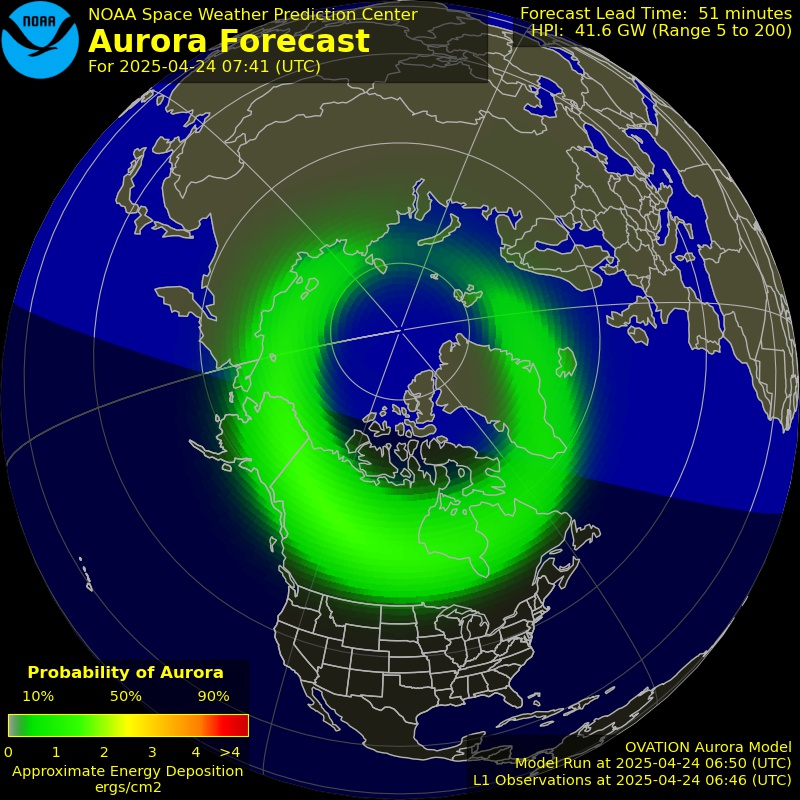
Use the local time attached to your city when planning a northern lights watch.
This article’s local windows and Kp 5.67 figure are the original forecast for its specified three-hour interval.
NOAA later observed a lower planetary K index in that same interval. This global measurement does not report city visibility.
What to do
- Use the city-specific three-hour peak window.
- Check local darkness, clouds and the live city forecast before leaving.
- Choose an open viewing spot away from direct lighting.
Sources and live checks
Original article figures use NOAA SWPC’s Planetary K-index forecast JSON retrieved October 10 at 19:03 UTC. NOAA’s forecast feed checked October 11 at 19:18 UTC records observed Kp 4.0 for 00:00–03:00 UTC on October 11, below the original Kp 5.67 forecast for that exact interval; this is not a city visibility report.